
Guest post for Southwest Distinctions
Saddle Leather on a Stage: Western Straps and Rock
I buy and sell vintage guitars for a living. Instruments come across my bench every week that are older than I am, and the first thing I look at is never the strap. That’s a mistake, and I’ll explain why by the end.
Here’s the part I understood late: of everything a player owns, the strap is the piece the audience actually sees. Nobody in the back row can tell a real PAF from a reissue. Nobody can read a serial number from forty rows out. What they see is a silhouette: a person, a guitar, and a band of leather running across the shoulder. It’s in every photograph ever taken of that player. It’s the one piece of gear that ends up on the album sleeve.
Most people spend four figures on the guitar and eighteen dollars on the strap.
The strap is the signature
Think about how few musicians you can identify from a shape alone. Stevie Ray Vaughan is one. Black leather, white music notes running its length, you do not need to see his face. That strap is as much a part of the picture as the beat-up Strat hanging from it.
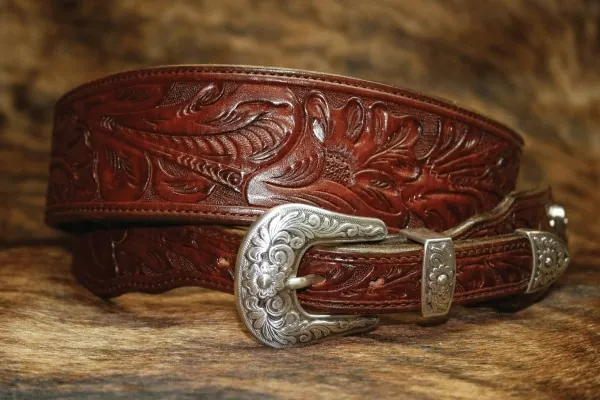
Waylon Jennings is another. His Telecaster wore a black hand-tooled leather cover, floral scrollwork, his initials, the flying W, and that guitar became the visual shorthand for an entire movement in country music. Fender’s Custom Shop later partnered with the Jennings family to recreate the iconic leather-clad Telecaster, which tells you something about how much of that guitar’s identity lived in the hide rather than the wood.
And then there are the Southern rock players, Dickey Betts among them, who took the whole Western look onstage and made it seem like it had always belonged there. None of that was an accident of fashion. There’s a real lineage behind it, and it runs straight through the American West.
From saddle shop to stage
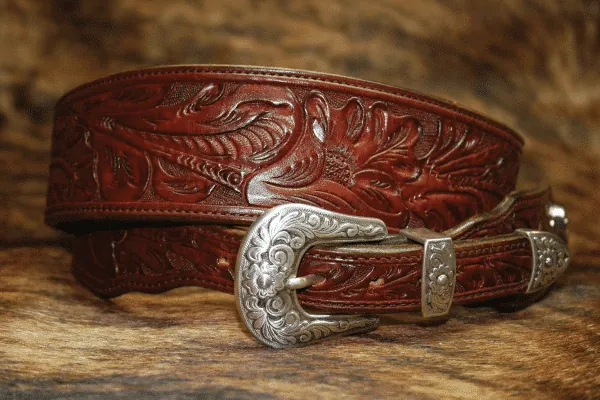
Before there was a music industry in Nashville, there were saddle makers. Tooling leather, laying out a floral pattern with a swivel knife, then bevelling, shading, and backgrounding it with a hammer and a set of stamps, was a working trade. It went on saddles and tack. It was decorative, but it lived on gear that got rained on, sat in the sun, and had to survive a horse.
That craft got pulled onto the stage in the middle of the last century. Rodeo tailors started dressing country performers, the Western look became the uniform of country music, and by the time the outlaw era arrived, tooled leather was fully established as part of the language. Southern rock inherited it. Blues players picked up pieces of it. It never really left.
What’s remarkable is how little the actual technique has changed. The swivel knife Don Mohr uses at his bench in Gold Canyon is the same tool a saddle maker was using a hundred years ago. Don learned it from an old-time saddle maker, the way it has always been passed along, one person at a bench showing another person at a bench.
Even the leather carries that history. Southwest Distinctions builds on Hermann Oak, a tannery that began in St. Louis in 1881 supplying harness leather for horse-drawn wagons heading west. Its traditional vegetable-tanning process uses tree-bark extracts and creates leather valued for firmness, workability, and carving. So when you hang one of these straps on a guitar, that is not a marketing story. That’s just what the material is.
Built like tack, not like a belt
Here’s the practical difference, and it matters more than the aesthetics. A cheap strap is a strip of dyed material with two holes punched in it. A saddle-built strap is a constructed object. Southwest Distinctions straps are vegetable-tanned Hermann Oak, leather-lined and padded. That means there is a second layer of finished leather against your shoulder, not raw suede or a sheet of foam that will compress into a pancake inside a year.
Vegetable tanning is the slow way. The hide is tanned with plant tannins in pits rather than run through a chrome bath in a day, and the result is a firm, dense leather that holds a tooled impression and develops a patina instead of simply wearing out. It is the only kind of leather worth carving, which is exactly why saddle makers use it.
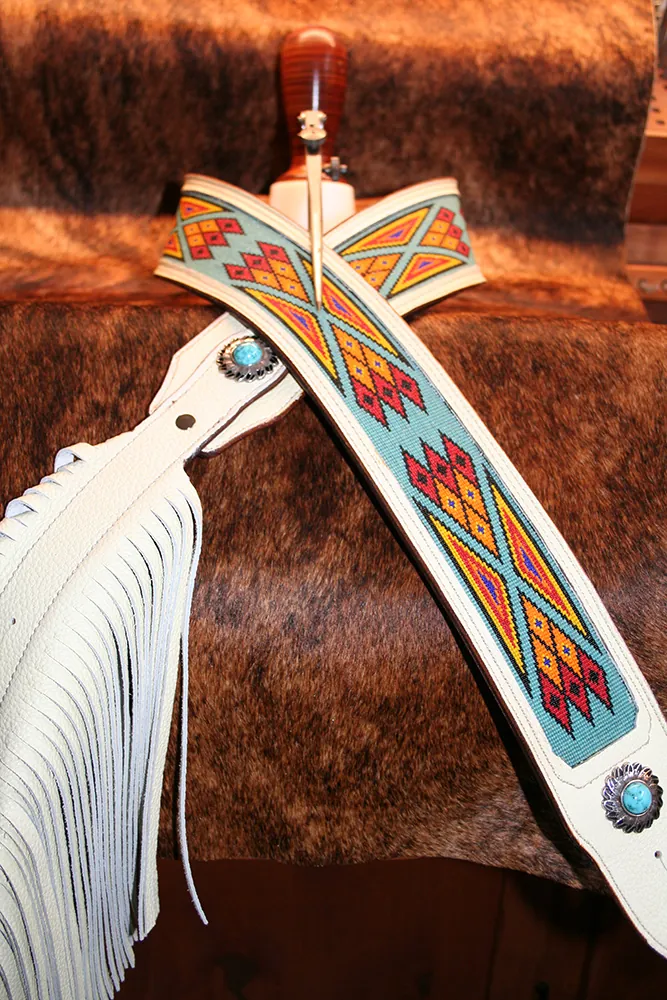
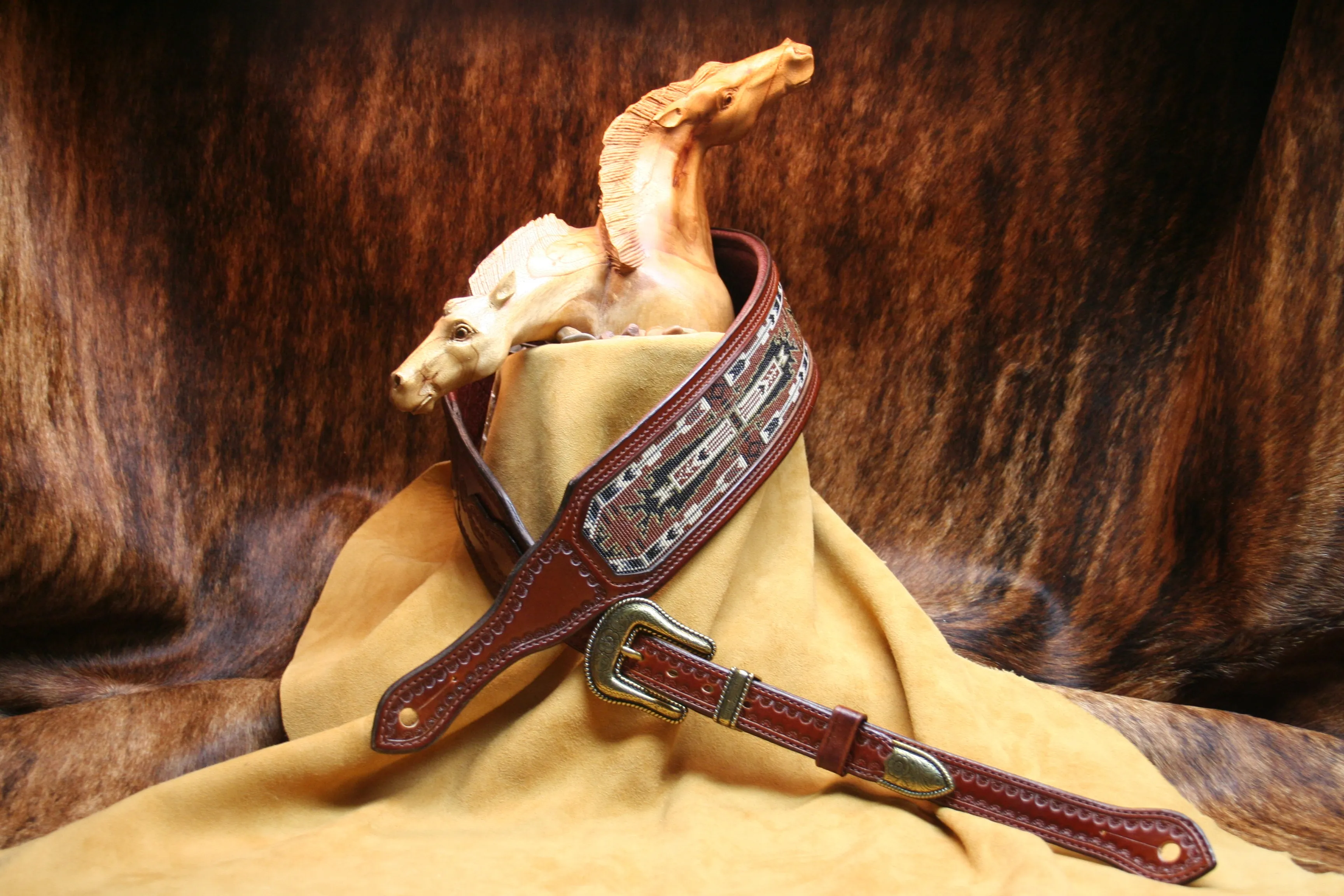
Then there is Barb Mohr’s beadwork, which is the part I genuinely have no comparison for. It is loom work: every bead threaded on a needle, one at a time, and woven by hand in size 15 Miyuki seed beads. One of their designs carries more than nineteen thousand beads in a single strap. That is not a decoration applied to a strap. That is a textile made by a person on a loom, then married to hand-carved saddle leather.
Add turquoise conchos, your choice of hole-and-slot or buckle-set hardware, a length cut for your body rather than a range of grommets, and Dunlop dual strap locks in the box. That is the spec sheet. It reads like tack because it is tack.
What I see from the other side of the counter
Now the part I know better than anyone: what straps do to guitars over sixty years. When an instrument comes into my shop, the wear tells the story before the owner does. A lot of what I find comes down to what was hanging the guitar up.
Strap buttons elongate. A heavy guitar on a thin strap concentrates all its weight on two small screws in two narrow holes. Over decades, the hole goes oval and the screw starts to work loose. On an original-finish instrument, that is a repair I would rather not have to make.
Weight distribution is not only a comfort issue, it is a wear issue. A slab-body electric can run ten pounds. Hang ten pounds off a two-inch nylon strip and all that load sits on one narrow line across your shoulder, while all the leverage sits on those two screws. A wide, lined, padded strap spreads the load. Your back notices in year one. The guitar notices in year thirty.
Cheap material and old finish do not get along. Vintage instruments wear nitrocellulose lacquer, and nitro stays chemically active for decades. I have seen dye transfer out of cheap backing and into a finish. I have seen soft vinyl and rubber-backed material leave permanent imprints and cloudy patches. Whatever sits against the back of that guitar for eight hours a week for twenty years is going to leave a record of itself.
Properly tanned, finished, lined leather is not the material that causes that problem. The bargain-bin stuff is. Buckle rash tells on the owner. So does the polish pattern where a forearm rode, and the wear at the heel. I can usually tell a gigged instrument from a closet queen inside thirty seconds, and a good share of what I’m reading is strap evidence.
Choosing one for your guitar
Match the width to the weight
The heavier the instrument, the more width and lining you want. On a heavy solidbody, wide is not a style choice, it is load management. On a light hollowbody or an acoustic, you have more freedom.
Decide fixed or adjustable honestly
If you play sitting and standing, or switch between a Strat and an archtop, you want adjustability. If you play one guitar, standing, at one height, a fixed-length strap cut to your measurement will hang better than any adjustable ever will. That is the advantage of having one made instead of bought.
Buckle set or hole-and-slot
Hole-and-slot is traditional and clean. A buckle set gives you finer adjustment and a little hardware presence up front. Both are correct. It is a look decision more than a function one.
Take the strap locks
Especially on anything vintage or heavy. The cost of a dropped guitar is not the cost of a strap.
Think about the guitar it will live on
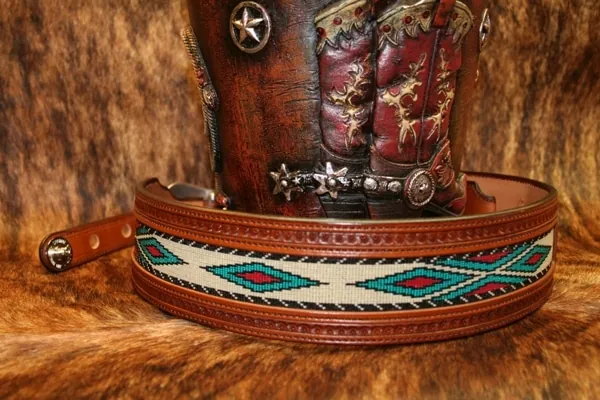
A tooled floral strap on a butterscotch Telecaster is a hundred years of American visual history stacked into one image. Loom beadwork against a sunburst archtop is something else entirely, and just as good. A strap should look like it was chosen for that instrument, because it was.
Made for the long haul
Choose the strap around your guitar, your height, and the way you play.
See the current handmade guitar strap collection, or start a custom order with Southwest Distinctions.
The last thing
Most of the guitars I handle have outlived their first owner. Some will outlive their third. That’s the strange thing about good instruments: you are not really buying them, you are keeping them for a while.
The hardware you hang them from ought to be built to the same standard. Not because a strap is precious, but because something made by hand from good material, by people who learned the trade from someone who learned it from someone else, will still be here in fifty years to hand along with the guitar.
There are not many benches like that left. There’s one in Gold Canyon.
Questions about leather guitar straps
Why choose a wider leather guitar strap for a heavy guitar?
A wider, lined strap spreads the guitar’s weight across more of your shoulder. That can make a heavy solidbody more comfortable over a long set and reduces the concentrated pull created by a narrow strap.
Should I choose a fixed or adjustable guitar strap?
Choose adjustable if you play different guitars or switch between sitting and standing. A fixed-length strap is a strong choice when you consistently play one guitar at one preferred height.
What leather works best for a tooled guitar strap?
Vegetable-tanned leather is valued for its firmness, carving ability, and ability to develop character with use. Southwest Distinctions uses Hermann Oak leather for its handmade guitar straps.
Related posts
Workshop guide
How to Make a Leather Guitar Strap
A practical guide to the leather, layout, construction, and finishing choices behind a durable handmade guitar strap.
Read the guide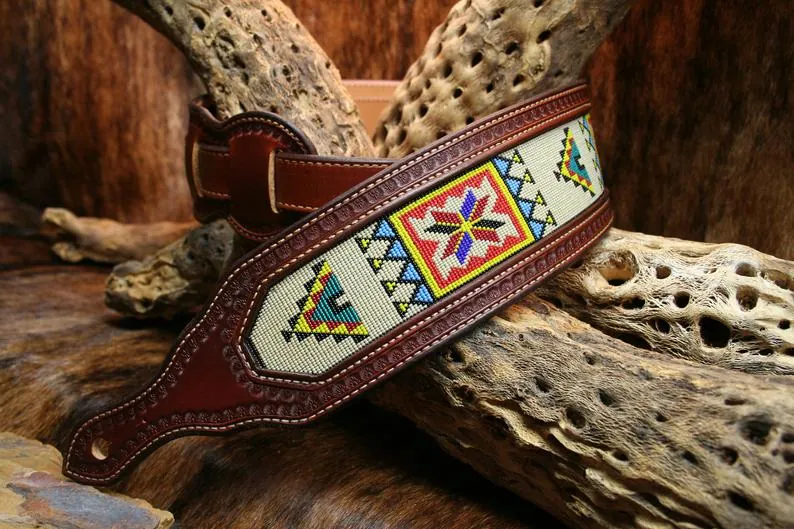
Fit guide
How to Adjust a Leather Guitar Strap
A practical way to set the right length, playing height, and comfort for a leather guitar strap.
Set your fit