
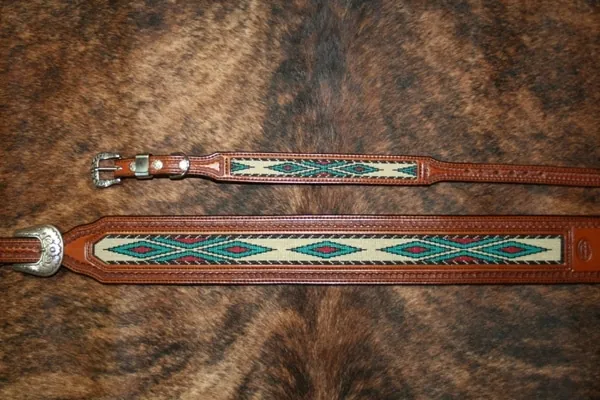
Guitar strap width changes how an instrument feels long before you notice the decorative work. A slim strap can feel light and free. A wider shoulder section can make a heavier guitar easier to carry through a rehearsal or a long evening of playing. The useful choice is not the widest strap available. It is the width that lets your guitar sit where you need it without making your shoulder work overtime.
That is why width is worth deciding before color, tooling, beadwork, or hardware. Your guitar’s weight, the way you move, and how long you play all matter. This guide gives you a practical way to test those factors, then translate what you learn into a leather strap that feels as intentional as it looks.
Start with the job your strap has to do
Think about the guitar first. A light electric used for short practice sessions does not ask the same thing from a strap as a dense solidbody, a large acoustic, or an instrument you wear through a three-hour set. The more weight you carry and the longer you carry it, the more useful a broad shoulder section can become.
Width changes the contact area between the guitar and your shoulder. A narrow strap puts the same load into a smaller band. A wider strap gives that load more room to spread. That does not make a wide strap automatically better. Some players prefer the movement and visual profile of a narrower build, particularly with a lighter instrument. It simply means width should match the real work the strap is doing.
A quick home test helps. Put your guitar on with the strap you already use. Stand at your normal playing height and play for ten minutes. Run through a chord progression, reach for the higher frets, and move the way you would at rehearsal. Notice whether the strap presses in one spot, whether the guitar drifts, and whether the problem begins right away or only after a few songs. That is more useful than choosing by a catalogue measurement alone.

Use a slim strap when freedom of movement matters most
A slim leather strap can be a fine choice for a light guitar, a player who moves a lot, or someone who wants a clean vintage profile. Less width keeps the strap visually quiet and can feel less bulky through the shoulder and neck. It also leaves more room for the guitar, clothing, and the player’s movement to lead the look.
The tradeoff is simple: a narrow edge has less shoulder coverage. On a light guitar, that may never become an issue. On a heavier instrument or a longer standing session, the same strap can begin to feel concentrated. If a slim strap feels good for one song but distracting by the end of rehearsal, listen to that. The problem may not be leather quality. It may be that the shoulder section needs more area.
Do not assume that a narrow strap must be uncomfortable or that a broad strap must be stiff. Leather weight, lining, padding, and the curve of the shoulder section all affect the result. The point is to choose the narrow profile because it suits the instrument and your playing, not because it is the only style you have seen.
Let a middle width handle the everyday work
For many players, a middle-width leather strap is a practical starting point. It has enough shoulder coverage for an ordinary electric or acoustic, while still feeling easy to move in and easy to pair with the shape of the guitar. It is the useful middle ground when you are not trying to solve a particular comfort problem but do want the strap to feel substantial.
Established leather-strap makers commonly offer two-inch and two-and-a-half-inch options, which is a helpful reminder that there is no single standard that fits every player. Fender’s artisan leather strap range, for example, includes both widths with adjustable length, giving a player room to balance shoulder coverage and a more compact feel. Fender’s product specifications show how small changes in width can sit within the same basic leather-strap format.
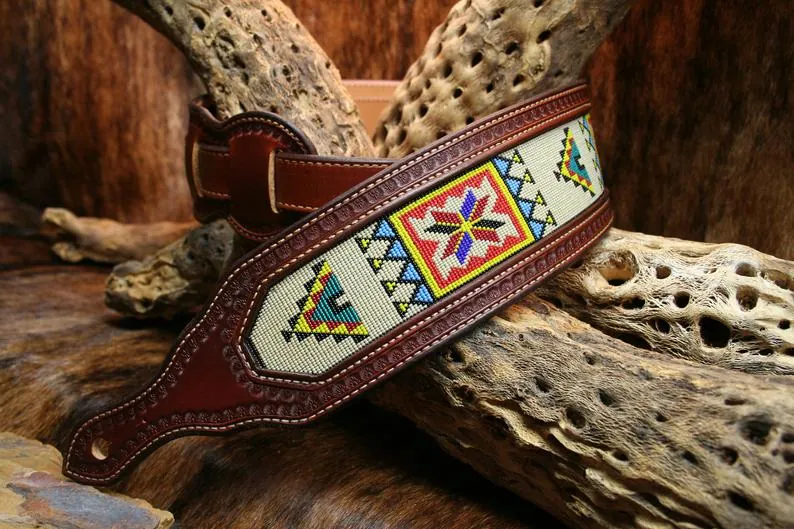
At this range, shape matters as much as the number. A strap can be broader at the shoulder and taper toward the ends, keeping the supportive part where you feel it without making the attachment points awkward. That approach also gives a maker room to place tooling, a hand-loomed beaded inlay, or a lining in a way that looks balanced on the body.

Choose more width when the guitar or the set asks for it
A broader strap is often worth considering when the instrument feels heavy, when you stand for extended rehearsals or gigs, or when you already know a narrow strap creates a hot spot on your shoulder. More coverage can make the guitar feel steadier and reduce the urge to keep shifting the strap back into place between songs.
Think of width as support, not a cure-all. If the guitar hangs too low, the right width will not fix the reach to your fretting hand. If the strap slides over a slick shirt, more leather alone may not solve the movement. If the leather ends do not fit securely around the strap buttons, comfort is beside the point. Set height, fit, and attachment first, then use width to make the carrying part of the job more comfortable.
Padding can add another layer of comfort, especially on a broad shoulder panel, but it has a different role. Width spreads the load. Padding softens what you feel where that load meets your shoulder. The Journal’s padded leather guitar strap guide explains how those two choices work together for a player who needs more support.
A wide strap can also make the leatherwork feel more like part of the instrument. It creates room for a tooled border, an inlaid band of beadwork, or a design that carries across the shoulder without being crowded. That visual space works best when it follows the function, not when it ignores it.

Set the length before judging the comfort
Width cannot make up for a guitar that hangs at the wrong height. Before you decide a strap is too narrow or too wide, set the instrument where your hands can actually work. Stand up with the guitar, play the material you know, and pay attention to your wrists, elbows, and shoulders. You should not have to lift a shoulder to reach the guitar or twist a wrist sharply just to play a familiar passage.
Some players like the guitar close to the chest. Others prefer a lower position. Neither is a problem if it lets you play comfortably, but it changes the length range you need. A strap that is right in width but cannot reach your preferred setting is not the right strap. Use the measurement guide and the Journal’s leather strap adjustment guide before committing to a fixed-length build.
For a custom strap, share how you play rather than only supplying a number. Tell the maker which guitar you use, whether you sit and stand, what feels wrong about the current strap, and whether you want a fixed or adjustable build. Those details turn a measurement into a strap that works in the real positions you use.
Check the working parts along with the shoulder section
The strap ends, adjustment, and hardware deserve the same attention as the width. A comfortable shoulder section is no help if the leather ends are stretched, the buckle lands directly on a pressure point, or the adjustment tail catches on clothing. Put the strap on, move through your usual playing positions, and notice where every working part lands.
Look for leather ends that sit fully under the strap-button heads and stay substantial around the holes. If you use locks, make sure they suit the guitar and are fully engaged. A good strap holds the guitar quietly in place, with no need for improvised fixes. The Journal’s guitar strap hardware guide walks through the details to check before a rehearsal, a show, or a long playing session.
It is also worth considering how width meets the hardware. A broad shoulder section can taper toward a smaller end, allowing the attachment to remain tidy and making room for secure, well-placed fittings. That transition is where thoughtful leatherwork shows itself: the strap feels purposeful from the shoulder all the way to the guitar.
Compare widths in the position where you really play
The easiest way to choose is to compare two widths with the guitar at your actual standing height. Do not judge from a quick try-on while the instrument hangs somewhere unfamiliar. Put each strap on, set the length, and play a little of the music that asks the most from you. A few open chords are useful, but so are the high-neck passages, seated transitions, and movements that happen during a real rehearsal.
Pay attention to four things. First, notice pressure: does one edge begin to make itself known on your shoulder? Second, notice stability: does the guitar stay where you set it or drift as you move? Third, notice reach: can both hands work naturally at the chosen height? Finally, notice bulk: a strap can be supportive yet still feel like too much if it catches under a jacket, crowds your neck, or pulls your attention away from playing.
Give the comparison enough time. A strap that feels comfortable for thirty seconds may reveal a pressure point after ten minutes. Conversely, a broader strap can feel unfamiliar at first because it covers more shoulder, then disappear once you begin playing. The goal is not to make the guitar feel weightless. It is to make the carrying part predictable enough that you can stop thinking about it.
If you are choosing a custom piece, take a few notes after the test. Describe the guitar, the strap width you tried, the playing time, where it felt good, and where it did not. That is far more helpful than saying a strap felt “off.” It gives the maker a clear starting point for the shoulder shape, padding, adjustment, and decorative layout.
Build the width around your own instrument
Southwest Distinctions makes handmade leather straps around the player and guitar first, then the personal details that make the piece yours. A strap can be shaped for a lighter guitar and a simple profile, built with more shoulder coverage for a heavier instrument, or planned with lining and padding for longer sessions. From there, hand tooling, beadwork, turquoise, conchos, and leather color can be arranged around a foundation that is already doing its job.
Start with the guitar strap collection to see finished examples, then use the custom guitar strap page to think through width, fit, shoulder support, and the kind of leatherwork you want to carry. When you are ready, custom orders are the place to bring a photo of your guitar, the strap you use now, and a few notes about what you would change.
Built for the way you play
Choose the shoulder support first. Make it personal from there.
Browse handmade leather guitar straps, or start a custom order with your guitar, playing height, and the details you want to see in the finished piece.
Questions about guitar strap width
What is a good width for a guitar strap?
A middle-width strap is a useful place to start for many guitars, but the right answer depends on the instrument’s weight, the time you spend standing, and how much shoulder coverage you like. Test it at your normal playing height before deciding.
Does a wider guitar strap help with a heavy guitar?
Often, yes. A broader shoulder section spreads the instrument’s weight across more of the shoulder. For a heavy guitar or a long set, that can feel more comfortable than a narrow strap, especially when the strap also has a well-planned padded section.
Is a narrow leather guitar strap comfortable?
It can be, particularly with a lighter guitar, shorter playing sessions, or a player who likes a close, low-profile feel. If a narrow edge starts to press into one place on your shoulder, try more width or a padded shoulder section.
Should a custom guitar strap be wide all the way to the strap buttons?
Not necessarily. Many well-made straps have a broader shoulder area and taper toward the ends. That gives the shoulder more support while keeping the strap manageable where it attaches to the guitar.
Related posts
Guitar Culture
How to Adjust a Leather Guitar Strap
A practical way to set the right length, playing height, and comfort for a leather guitar strap.
Read the guide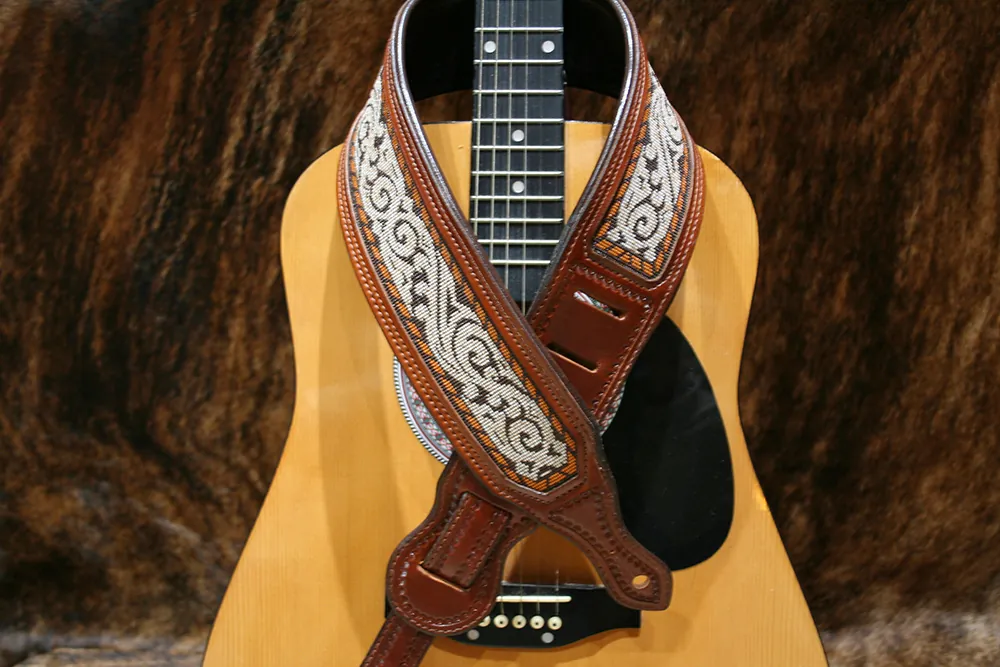
Guitar Culture
Padded Leather Guitar Straps: How to Choose One
A practical guide to choosing a padded leather guitar strap for the right width, length, support, and playing comfort.
Read the guide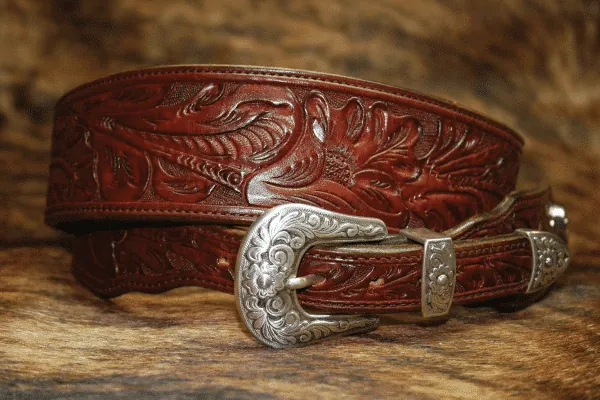
Guitar Culture
Tooled Leather Guitar Straps: What to Look For
A practical guide to choosing a tooled leather guitar strap for the right pattern, leather, fit, and long-term use.
Read the guide